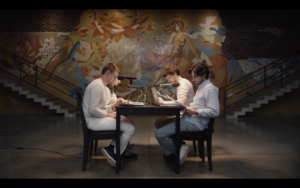
Coincidental Method and the Calculation of Environments
Identifying the core conflict of a situation requires a willingness to notice coincidences. However, will alone is not enough—a basic literacy is also necessary, one that enables reading. The key breakthrough in the development of the coincidental method over the past year has been the creation of the “calculation of environments,” based on a typology of minimal contact. This innovation makes such reading accessible to everyone. The current project is dedicated to this theme and its practical implications.
At the heart of the coincidental method lies the question of super-determined identification of a situation’s central conflict—and the possibility of developing protocols that ensure conflict resolution and an increase in the degree of its reality.
A key imperative for the Coincidental Institute is the translation of acquired knowledge into mass applicability, ensuring it can be used by anyone. In this project, recent developments will be presented and transformed into tangible sensory objects.
After the presentation, a discussion will take place within the framework of the binary pair “light/heavy,” proposed by Triennale recommender and artist Anatoly Osmolovsky, as well as an exploration of the mathematics of elementsand its potential practical applications.
Participants in the discussion:
- Members of the Coincidental Institute
- Members of the BKB Group
- Mikhail Kurtov (Institute of Techno-Theology)
- Artist Anatoly Osmolovsky
- Art critic Lera Kononchuk
- Co-curator of the 2nd Triennale, Valentin Dyakonov